Treehouse is a homeschool co-op the boys have attended for the last two semesters. We meet with a large group of homeschoolers every Thursday for a wide variety of classes taught by parents and outside instructors. The boys love going and have made many friends there. This semester, Brennan took a Pre-school class (New Horizons), Music, and Playground Games. Rich took Prairie Primer (more below), Math, Space, Cooking, and Paper Crafts. The Spring Gala is a fundraiser and a chance for the students to perform skits, songs, and recite poetry they've learned over the course of 12 weeks.
Toe-Knee Knows
Rich's "Prairie Primer" class did projects based on the Little House books. They made Hogbladder balls and Corncob dolls, made their own butter, and learned how to square dance.
Brennan does the Finger Polka!
4/30/10


4/18/10
Timeline
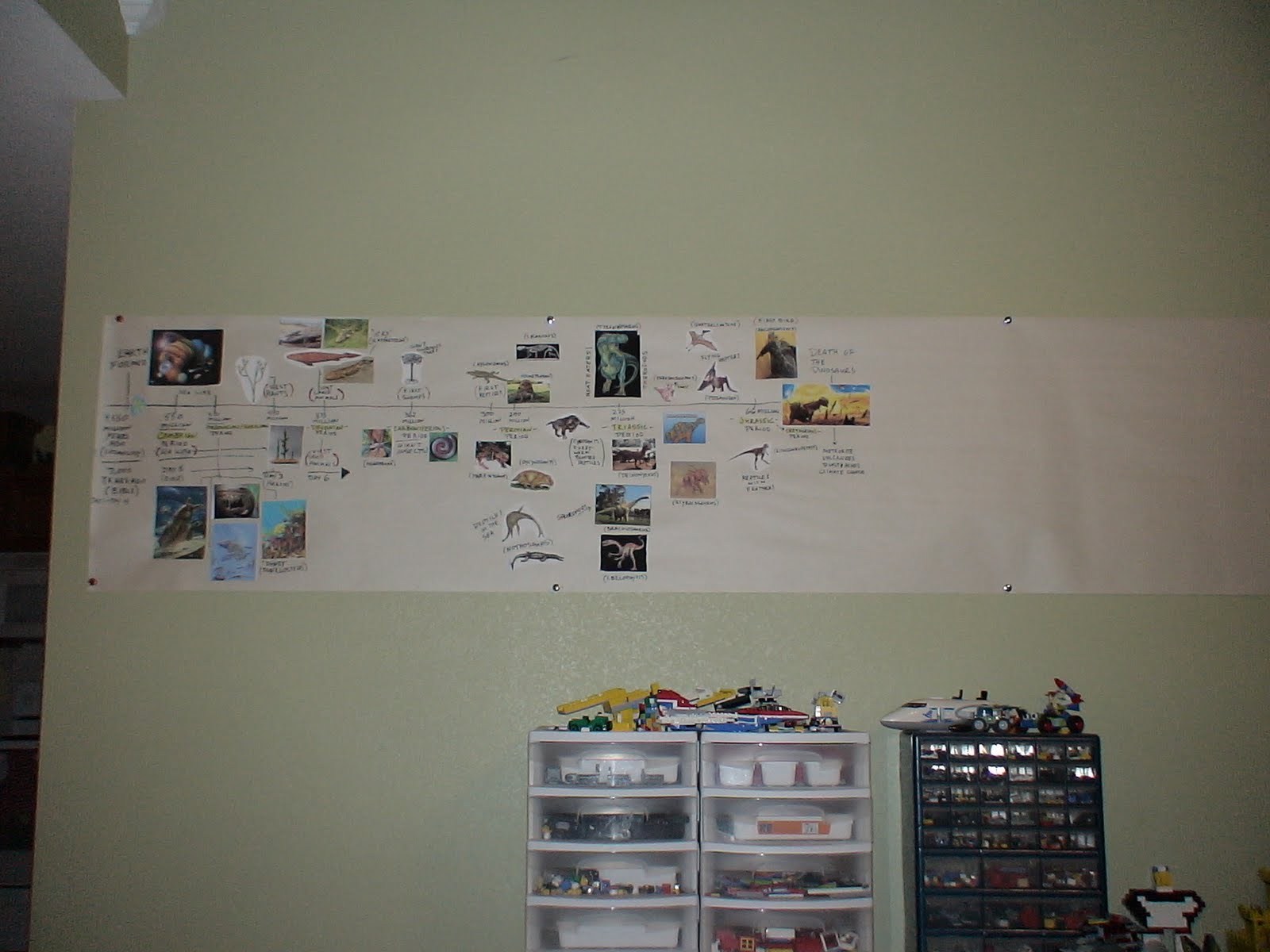


A few months ago, we hung a long piece of butcher paper across the wall to keep track of all the time periods and pre-dinosaur animals we've been learning about. Rich likes to know "which came first" so it's a nice visual way to remember. This summer, we'll have to start filling in some spaces much further down because we keep running across things like the building of the pyramids, Abe Lincoln, and WWII. I have a feeling we'll need a much longer sheet when we get to European history.
4/5/10
Rich's Journal
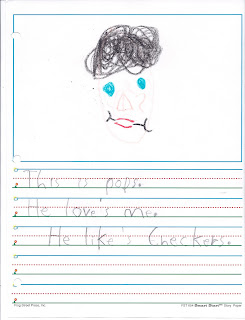
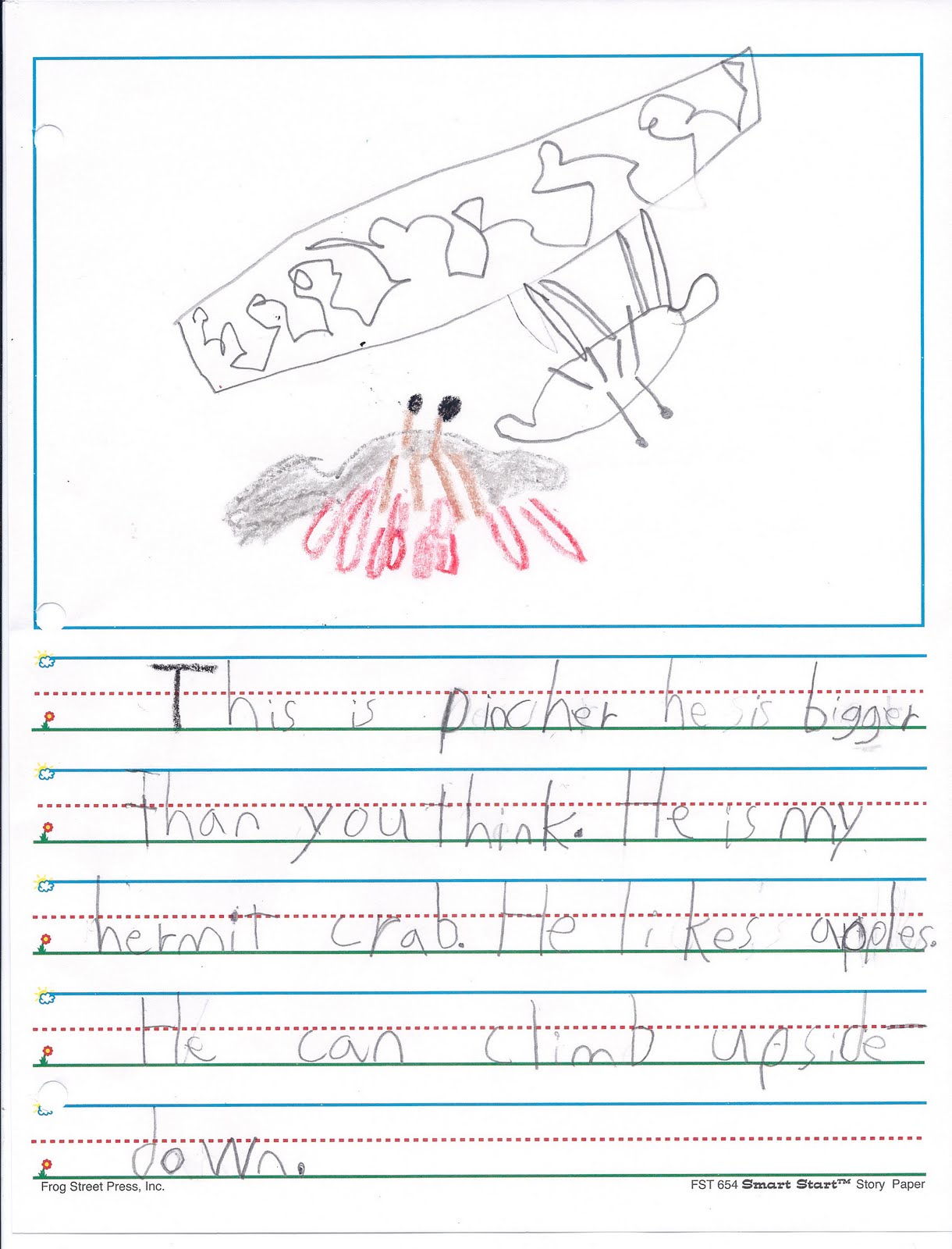
Rich wrote about his family earlier this year for his journal project. Here are the scans - click the individual pictures for a larger version.




3/15/10
What Are You Learning in Homeschool Right Now?


The boys (and mom and dad) get this perplexing question so often, but it's the hardest thing to answer. The more appropriate question might be, "What are you not learning right now?"
The boys are both starting to remember what they knew as toddlers: Learning happens all the time, everywhere, whether you like it or not. We learned about the different parts of plants that we eat while meandering through the produce section this afternoon. We learned about the muscles in the human leg when mom tore one a few weeks ago. We learned about brass instruments when we cleaned out a closet and found mom's old saxophone. We learned about death when we had to put down our dog of 15 years last month. Learning is life, life is learning.
I could tell you what we're purposefully learning, I guess. Short and long vowel sounds. Everything you never wanted to know about nouns and predicates. Multiplication. Early reptiles and fish like Dunkleosteus (the boy's favorite - Google it) that lived during the Devonian period. How green beans grow. What happens when you mix primary colors. The history of Carnivale! in Brazil, the Incan people, and the Yanomami hunters of the Venezuelan rain forest. Why The Phantom Tollbooth is one of the greatest books ever written (it is, trust me). Building volcanoes that erupt.
The problem with lists like that is it makes everything sound so segmented and clinical, when in fact, every one of those things are linked somehow, and we usually find ourselves wandering happily from one interest to the next. It's not that we don't use textbooks and worksheets, it's just that I never know where we're going to end up. But it's always enlightening, and never where I would have gone myself.


2/1/10
February Already?


I haven't posted because we've been busy with trips, family, snow, and illness. But we're back! We started planning more "structured" time for this semester to make sure we're covering everything. Rich has especially taken an interest in cosmology (not to be confused with cosMOTology), fossils, and the passage of time. We're starting more formal music "classes" with Brennan on Friday, which should be fun. Lots of pictures!
Making Fossils


They made their own planets out of Play-Doh.
Planet "Colorful" and Planet "Double Rings"


Rich explaining the ecology of his planet:
We journal every morning about whatever we want. Rich has written about all his immediate family, so now he's starting on extended family:

11/19/09
Okay, so The Arts. This may get long because it's something I'm dead serious about.
Last month, Parents Magazine ran an article called "Why Art Makes Kids Smarter." Now, Parents Magazine is usually, to put it gently, full of crap about everything from parenting to education, but the article made a point that has been well known in education circles for years: artistic expression actually improves a child's grasp of "core" subjects like math, literacy, and science.
They described three schools, in Arizona, California, and New York who actually improved their test scores by adding more art classes to their curriculum, as well as incorporating it into other subjects. This is counter to the popular tactic of cutting art funding to accomplish the same goals (hint: it doesn't, and never will, work). The Regio Emelia schools in Italy have been doing this for years with great success, while the U.S. has been viciously cutting funding for art class, shop class, band, and any other subject that doesn't rate a section on the standardized test.
I've been beating this drum since Rich was in kindergarten, not because I gave a rip how he did on standardized tests, but because when implemented consistently, art in its many forms gives birth to skills that are not obtained from "the three R's" - it teaches the use of metaphor, imaginative thinking, three dimensional problem solving, structure and form, engineering conceptualization...I could go on an on (can you tell?)
I was pulled out of third grade math for a special art class, therefore missing key math concepts which haunt me to this day. The intention was good, but the methodology was flawed. I hate math, but if you use art to teach me math - Bingo! But we have such a faulty, compartmentalized view of education that we're still trying to separate the fine arts from other disciplines, instead of blending them in. And the Renaissance chuckles at us and clicks it's tongue from the annals of history.
I think kids are like this about pretty much all subjects. Art turns the learning over to the child because it is by nature subjective. They can approach creating something in whichever way seems best to them, and it doesn't matter if they get it right. It allows them to fail (Yes, the "F" word that's feared and dreaded in public education, despite the fact that brilliant minds from DaVinci to Einstein cite it as the key to success. Hey, it's not the teachers' fault. They're not the ones who insisted that No Child be Left Behind - or rather that No Textbook or Testing Company Be Left Unpaid. But I digress...). The good news, and hopefully a nail in the coffin of the NCLB Act, is that the current administration has launched an extensive assessment of the state of art education in the U.S. for these very reasons. The survey results won't be in until 2011, but at least there's finally an acknowledgment that the Draconian NCLB Act needs to be replaced with something positive and holistic, and that the Arts should play a key role.
Most objections to this approach come from well meaning people who often insist we must return to "the basics" of education ("the three R's") and do away with such frivolous subjects as design, drawing, dance, Latin, music and other disciplines of a classical education. I argue that if we're going to train kids to be architects, graphic designers, software engineers, biochemists, or nuclear physicists, they need the imaginative, creative skills that are only afforded when education is approached with imagination and creativity. They need art. Traditional public education is designed to train people to work in factories, which is fine if that's what you love to do, but that outdated system is a product of the industrial age, not the post-tech age that is upon us. The long view of education must have art at its core, even if the child is not "artistically inclined" (and honestly, have you ever known a kid that wasn't? Public education sometimes beats it out of them). Rich was fortunate enough to have an awesome Kindergarden teacher for constantly engaged the kids in art projects, but as he moved up, art was gradually phased out until he only got it in a "specials" class one hour a week. It's not about them learning how to paint beautifully or sight read Mozart's Concerto in B. It's about them developing, through artistic means, the skill set that will make them a better scientist, mathematician, writer, or athlete.
Sermon over. Go draw something. :)


Last month, Parents Magazine ran an article called "Why Art Makes Kids Smarter." Now, Parents Magazine is usually, to put it gently, full of crap about everything from parenting to education, but the article made a point that has been well known in education circles for years: artistic expression actually improves a child's grasp of "core" subjects like math, literacy, and science.
They described three schools, in Arizona, California, and New York who actually improved their test scores by adding more art classes to their curriculum, as well as incorporating it into other subjects. This is counter to the popular tactic of cutting art funding to accomplish the same goals (hint: it doesn't, and never will, work). The Regio Emelia schools in Italy have been doing this for years with great success, while the U.S. has been viciously cutting funding for art class, shop class, band, and any other subject that doesn't rate a section on the standardized test.
I've been beating this drum since Rich was in kindergarten, not because I gave a rip how he did on standardized tests, but because when implemented consistently, art in its many forms gives birth to skills that are not obtained from "the three R's" - it teaches the use of metaphor, imaginative thinking, three dimensional problem solving, structure and form, engineering conceptualization...I could go on an on (can you tell?)
I was pulled out of third grade math for a special art class, therefore missing key math concepts which haunt me to this day. The intention was good, but the methodology was flawed. I hate math, but if you use art to teach me math - Bingo! But we have such a faulty, compartmentalized view of education that we're still trying to separate the fine arts from other disciplines, instead of blending them in. And the Renaissance chuckles at us and clicks it's tongue from the annals of history.
I think kids are like this about pretty much all subjects. Art turns the learning over to the child because it is by nature subjective. They can approach creating something in whichever way seems best to them, and it doesn't matter if they get it right. It allows them to fail (Yes, the "F" word that's feared and dreaded in public education, despite the fact that brilliant minds from DaVinci to Einstein cite it as the key to success. Hey, it's not the teachers' fault. They're not the ones who insisted that No Child be Left Behind - or rather that No Textbook or Testing Company Be Left Unpaid. But I digress...). The good news, and hopefully a nail in the coffin of the NCLB Act, is that the current administration has launched an extensive assessment of the state of art education in the U.S. for these very reasons. The survey results won't be in until 2011, but at least there's finally an acknowledgment that the Draconian NCLB Act needs to be replaced with something positive and holistic, and that the Arts should play a key role.
Most objections to this approach come from well meaning people who often insist we must return to "the basics" of education ("the three R's") and do away with such frivolous subjects as design, drawing, dance, Latin, music and other disciplines of a classical education. I argue that if we're going to train kids to be architects, graphic designers, software engineers, biochemists, or nuclear physicists, they need the imaginative, creative skills that are only afforded when education is approached with imagination and creativity. They need art. Traditional public education is designed to train people to work in factories, which is fine if that's what you love to do, but that outdated system is a product of the industrial age, not the post-tech age that is upon us. The long view of education must have art at its core, even if the child is not "artistically inclined" (and honestly, have you ever known a kid that wasn't? Public education sometimes beats it out of them). Rich was fortunate enough to have an awesome Kindergarden teacher for constantly engaged the kids in art projects, but as he moved up, art was gradually phased out until he only got it in a "specials" class one hour a week. It's not about them learning how to paint beautifully or sight read Mozart's Concerto in B. It's about them developing, through artistic means, the skill set that will make them a better scientist, mathematician, writer, or athlete.
Sermon over. Go draw something. :)


11/18/09
Lapidaries, Leatherworks, and Pottery Wheels. Oh My!
Last week was so filled up it took me until today to catch up (like I ever really catch up...). Last Wednesday we went to a Lapidary (a gem/rock/mineral expert) in Gentry. Huge collection of rocks and grinding/cutting/polishing equipment. The boys were fascinated. Mr. Dean turned us on to a local "Rock Hounds" club that takes trips to dig for fossils and gems. We ate lunch at a fabulous Mennonite restaurant called the Wooden Spoon (do not miss this if you happen to be in Gentry sometime - order pie. You're welcome). Then we explored at a flea market and went home exhausted..
Friday was our first visit to the Crafty Cottage in Bentonville. The boys got to try their hand at ceramic painting, pottery, and leatherworking. Really cool place, really cool people. The boys like the pottery wheel the best. If anyone has a used one lying around, we'll take it off your hands. They only cost about $10,000!
Pottery Wheel
nu=4459)642)258)WSNRCG=32+9%3B7%28776335nu0mrj.jpeg)
nu=4459)642)258)WSNRCG=32+9%3B7%28993335nu0mrj.jpeg)
nu=4459)642)258)WSNRCG=32+9%3B7%2898+335nu0mrj.jpeg)
Leather Works


Today, they've been up to their elbows in molding clay (we discovered that snakes are a good starting place) and getting ready to paint a cardboard playhouse. Seems like a lot of arts stuff this week, but I'm convinced that time correctly invested in art, pays off tenfold in other disciplines, and the stats back me up. More on that later!
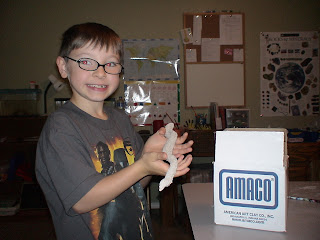


Friday was our first visit to the Crafty Cottage in Bentonville. The boys got to try their hand at ceramic painting, pottery, and leatherworking. Really cool place, really cool people. The boys like the pottery wheel the best. If anyone has a used one lying around, we'll take it off your hands. They only cost about $10,000!
Pottery Wheel
nu=4459)642)258)WSNRCG=32+9%3B7%28776335nu0mrj.jpeg)
nu=4459)642)258)WSNRCG=32+9%3B7%28993335nu0mrj.jpeg)
nu=4459)642)258)WSNRCG=32+9%3B7%2898+335nu0mrj.jpeg)
Leather Works


Today, they've been up to their elbows in molding clay (we discovered that snakes are a good starting place) and getting ready to paint a cardboard playhouse. Seems like a lot of arts stuff this week, but I'm convinced that time correctly invested in art, pays off tenfold in other disciplines, and the stats back me up. More on that later!


Subscribe to:
Posts (Atom)